

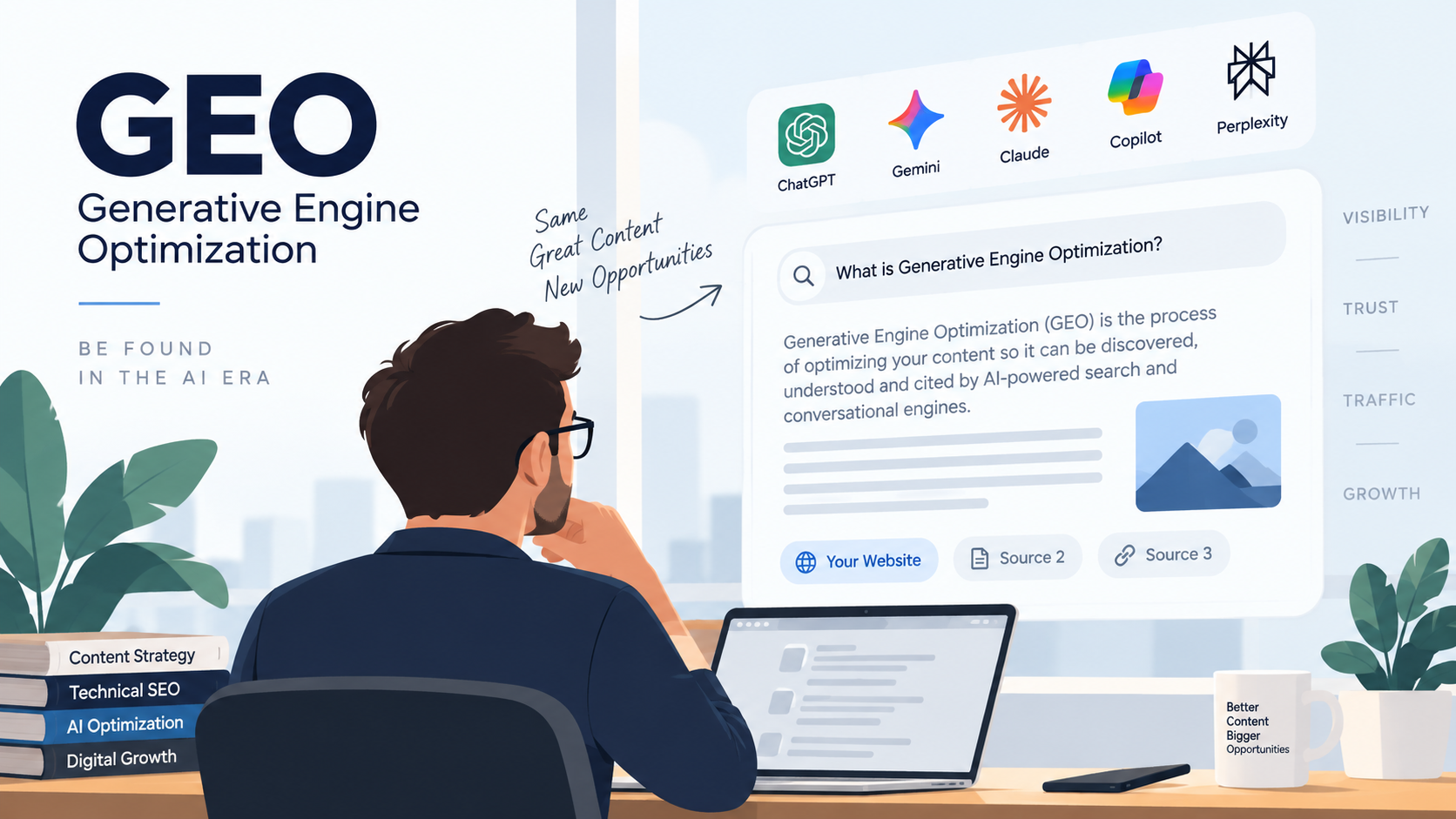
GEO (Generative Engine Optimization): What It Is and Why Your Online Store Should Care
When a potential customer asks ChatGPT, Gemini or Google's AI Overviews "which online store has the best office headsets", the answer they get is not a list of ten blue links. It is a text that the model composes from sources it considers trustworthy. If your store does not exist in those sources in a way an AI can read and evaluate, you are simply out of the conversation. That is exactly where GEO comes in.
What is Generative Engine Optimization?
Generative Engine Optimization (GEO) is the practice of preparing a website's content and technical infrastructure so that it appears inside the answers produced by AI systems: ChatGPT, Perplexity, Claude, Gemini, AI Overviews and every new generative search engine.
The term was established by academic research published in 2023 and presented at KDD 2024. The researchers showed that specific content changes —clarity, structure, citations, credible information— can increase a source's visibility in generative engine responses by up to 40%. Since then, the term has been used more broadly for the whole practice of adapting a site to the LLM era.
The essential difference from what we knew is this: in classic SEO you compete for a position on a results page. In GEO you compete to become part of the answer itself.
GEO and SEO: differences and overlaps
GEO does not replace SEO. Generative systems are fed by the same web that Google ranks, so a technically healthy site with good content already has a serious head start. There are, however, differences worth clarifying:
- SEO measures rankings and organic traffic. GEO measures mentions, citations and presence inside generated answers.
- SEO focuses on keywords and backlinks. GEO focuses on how easily a model can extract and quote a piece of information from your page.
- SEO deals with crawlers that index pages. GEO also deals with AI crawlers that read your site in real time, at the moment the user asks the question.
In practice, a sound strategy today treats them as one unified effort, not two competing projects.
Why GEO matters specifically for online stores
For an e-shop this is not a theoretical issue. Users already ask AI assistants for product suggestions, comparisons, prices and store trustworthiness. Those answers act like a salesperson that never sleeps: if your brand is mentioned there, you enter the set of options the customer will consider. If not, they never see you.
At the same time, agentic commerce is maturing. AI agents do not just answer questions — they prepare purchases, compare carts and gradually complete transactions. A store that is not readable by these systems will find itself where a site without a mobile version was in 2010: technically functional, practically invisible.
What an online store needs in practice
Applying GEO to an e-shop involves work on three levels:
1. Content
Product descriptions and pages that answer real customer questions, with clear language, structured sections and verifiable information. Content must be written so that a model can isolate a paragraph and quote it as an answer.
2. Technical access for LLMs
Robots.txt rules for AI crawlers, an llms.txt file, proper structured data (schema.org), sitemaps, clean feeds and —where needed— structured catalog access via API or recent standards such as the Model Context Protocol (MCP) and the Universal Commerce Protocol (UCP).
3. Optimization and consistency
Models prefer sources that are fresh, consistent and technically fast. In parallel, brand mentions on credible third-party sites play a role similar to backlinks in classic SEO.
Why implement it with us
At HOT WEB DESIGN we do not talk about GEO in theory. We have built in-house the tools an online store needs to cover all three levels:
- MCP Server for PrestaShop: connects your store directly with LLMs, so that management, content and analysis happen with AI assistance on your real e-shop data.
- UCP Server: exposes your catalog, prices, stock and checkout to AI agents through the Universal Commerce Protocol, giving LLMs structured and secure access to your store.
- AI modules: dedicated PrestaShop modules connected to LLMs for product descriptions, translations, SEO and content optimization at scale.
Whether we are talking about content, about the access LLMs have to your site, or about overall technical optimization, the work happens on your own PrestaShop e-shop with tools we have already built and tested — not with promises. And wherever something specialized is required, we develop it as a custom PrestaShop module.
What to keep
GEO is neither a fad nor a replacement for SEO. It is its logical continuation in an environment where answers are generated rather than simply ranked. The earlier an online store prepares —content, structured data, access for AI systems— the harder it will be for competitors to catch up later.
If you want to see where your own e-shop stands today against generative engines, and which changes have real value for your case, get in touch with us.