

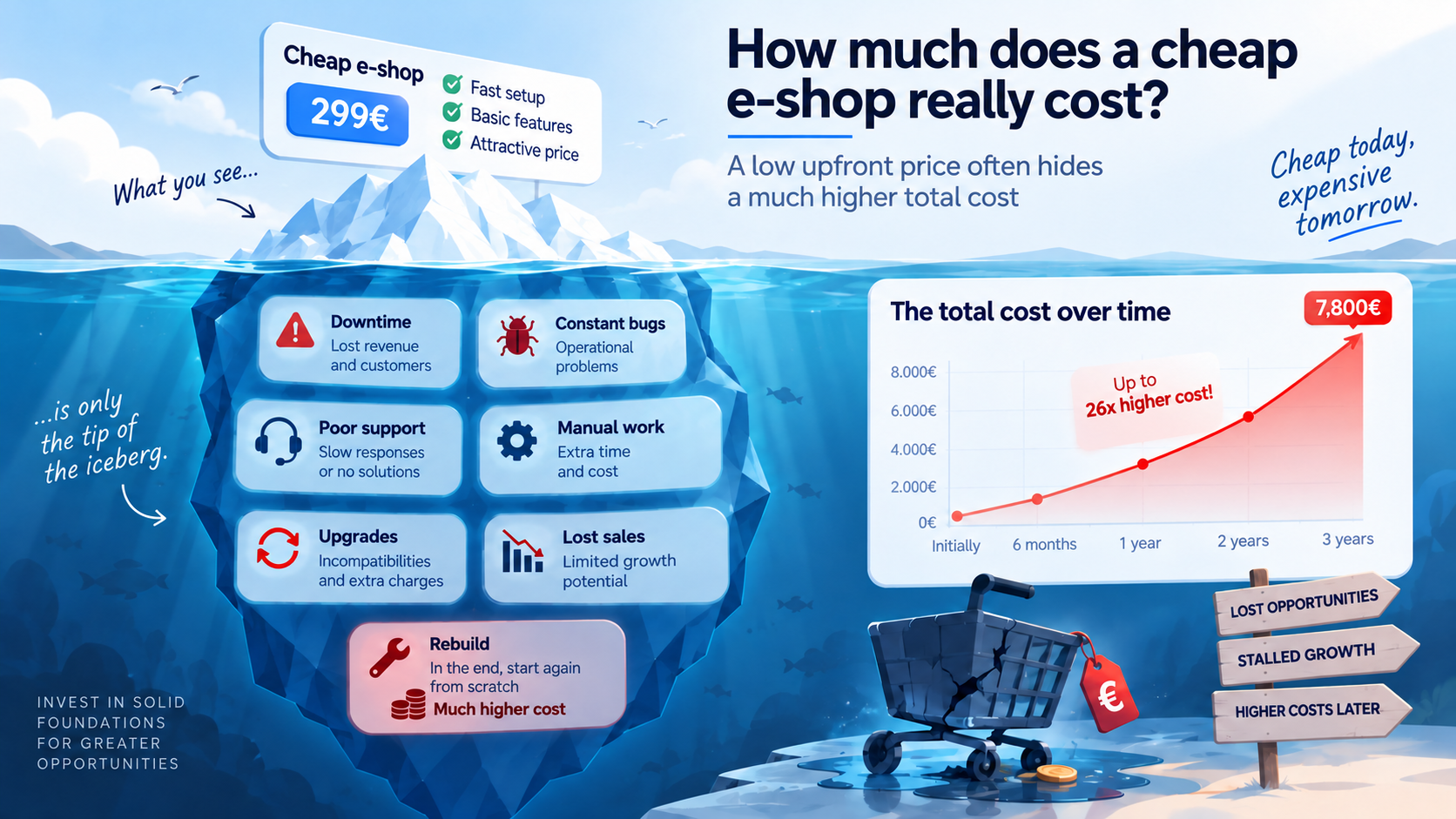
The True Cost of a Cheap Online Store
You ask several agencies for a quote to build your online store.
One proposal comes back significantly cheaper than the others.
Naturally, you wonder why you should pay more when both providers are offering to build an e-commerce website.
It is a reasonable question. Every business needs to manage its expenses carefully.
But there is another question worth asking before you make your decision:
What exactly am I buying, and how much will this website cost me over the next few years?
An online store is not a one-off design project that you purchase and forget.
It is a business system that must operate every day, process payments, manage customer information, support orders, receive updates and adapt as your business grows.
A low initial price can represent excellent value.
It can also hide substantial costs that only become visible after the website has been delivered.
The first mistake: comparing prices instead of deliverables
Two development proposals may mention the same platform, similar designs and identical basic features.
That does not mean they offer the same service.
One may cover a standard theme installation, essential configuration and a few payment options.
Another may include requirements analysis, customised purchasing workflows, technical SEO preparation, performance optimisation, integration testing and a structured deployment process.
You may not need every available service from day one.
However, you should know what is included, what is excluded and what additional work might cost later.
A cheap website is not necessarily a bad website.
The problem begins when its low price is possible only because important requirements have been overlooked or left unexplained.
Hidden cost 1: Essential features that were never included
You launch the store and begin using it.
Then you discover that connecting your ERP requires an additional fee. Your shipping calculations do not cover certain products. A discount cannot be configured the way your business needs it. Integrating another delivery provider requires a separate module.
Charging for additional functionality is not inherently unreasonable.
The issue is whether the original project properly assessed your requirements and explained the scope.
A professional proposal should make the included functionality clear and identify important exclusions, third-party licence costs and assumptions.
It should also describe how future changes will be estimated.
Without that clarity, the attractive initial price can become a series of unexpected expenses.
Hidden cost 2: Sales that never happened
This may be the most significant cost, precisely because it does not appear on an invoice.
A slow product page, a confusing checkout or a poor mobile experience can make customers less likely to complete a purchase.
Consider a hypothetical example.
An online store receives 3,000 visits per month, with an average order value of €80 and a conversion rate of 2%.
That produces 60 orders and €4,800 in monthly revenue.
With the same traffic and average order value, a conversion rate of 1.5% produces only 45 orders and €3,600 in revenue.
The difference is €1,200 per month, or €14,400 over twelve months if those conditions remain unchanged.
This does not prove that a poorly built website caused the lower conversion rate. Pricing, product selection, customer intent, competition and traffic quality also influence purchasing behaviour.
However, it illustrates why conversion performance matters financially.
If technical issues are preventing customers from completing purchases, their cost may eventually exceed the money saved on the original development project.
And unlike a development invoice, lost sales are not always immediately visible.
Hidden cost 3: Support that disappears when something breaks
Imagine launching an important advertising campaign only to discover that customers cannot complete checkout.
Or finding out that orders are not being transferred to your ERP, stock levels are incorrect or a payment integration has stopped working.
At that moment, the amount you originally saved on development offers little comfort.
You need someone capable of diagnosing and resolving the problem.
Not every store needs round-the-clock technical support. But every business should understand the support arrangements available to it.
Who handles incidents? What response times are agreed? What counts as an emergency? Are security updates, backups and module compatibility checks included?
These questions should be answered before a serious problem occurs, not afterwards.
Reliable technical support has a cost. So does the absence of it.
Hidden cost 4: Upgrades become increasingly expensive
E-commerce software needs maintenance.
Security updates, compatibility changes, payment provider requirements and platform upgrades are part of operating a website over time.
If the original implementation contains poorly documented modifications, incompatible extensions or unnecessary changes to the platform's core code, future updates can become considerably more difficult.
Instead of a controlled upgrade, you may face repeated repairs, module replacements and redevelopment.
Eventually, the technical debt can become substantial enough that a partial or complete rebuild is proposed.
At that point, you may find yourself paying again for functionality you thought you had already purchased.
The original development price was low. The long-term maintenance cost was not.
Hidden cost 5: Your business outgrows the website
Your online store works adequately today.
But what happens when you want to introduce wholesale sales, connect multiple warehouses, expand to marketplaces, integrate an ERP or offer more advanced purchasing options?
If the website was not implemented with maintainability and extensibility in mind, every new feature may require extensive workarounds.
Sometimes the feature can be developed, but at a disproportionate cost. In other cases, accumulated technical limitations make further development commercially unattractive.
The hidden cost is not only the price of the additional software.
It includes the time spent on manual processes, delayed launches and business opportunities that cannot be pursued when you need them.
A growing business needs the flexibility to respond to its market.
A website that prevents it from doing so is no longer simply a cheap website. It has become a business constraint.
What should an e-commerce website really cost?
There is no universal price that makes an online store good or bad.
A small business with a limited catalogue and straightforward requirements may be perfectly well served by a relatively simple implementation.
A more established operation with ERP integrations, multiple sales channels, extensive stock management and custom commercial processes has a different set of needs.
The useful measure is not just the initial development price.
It is the total cost of ownership over time, including hosting, software licences, maintenance, support, integrations, upgrades and future development.
Business performance matters too.
An expensive website is not automatically well engineered. A low-cost website is not automatically unsuitable.
What matters is whether the solution is appropriate for your requirements and whether the provider can support its continued development.
Before accepting a proposal, ask what is included, how future changes are handled, how software upgrades are performed and who will be responsible for technical support.
Ask what happens if you need functionality that does not exist in the standard platform.
The quality of those answers can tell you more than the headline price.
Avoid paying twice for the same online store
Choosing a development partner is not about spending as much money as possible.
It is about understanding the investment you are making.
If your online store is an important sales channel, the quality of its implementation, its reliability and its ability to support future business requirements deserve serious attention.
At Hot Web Design, we approach e-commerce website development as a long-term business investment.
We work with PrestaShop, develop custom modules and build integrations for businesses whose requirements extend beyond standard website functionality.
If you are planning a new online store or dealing with recurring problems in an existing one, contact our team to discuss what your business needs and how it can be supported.
The goal is not to pay the lowest possible price on the day your website launches. It is to make an investment that continues to make sense as your business grows.