

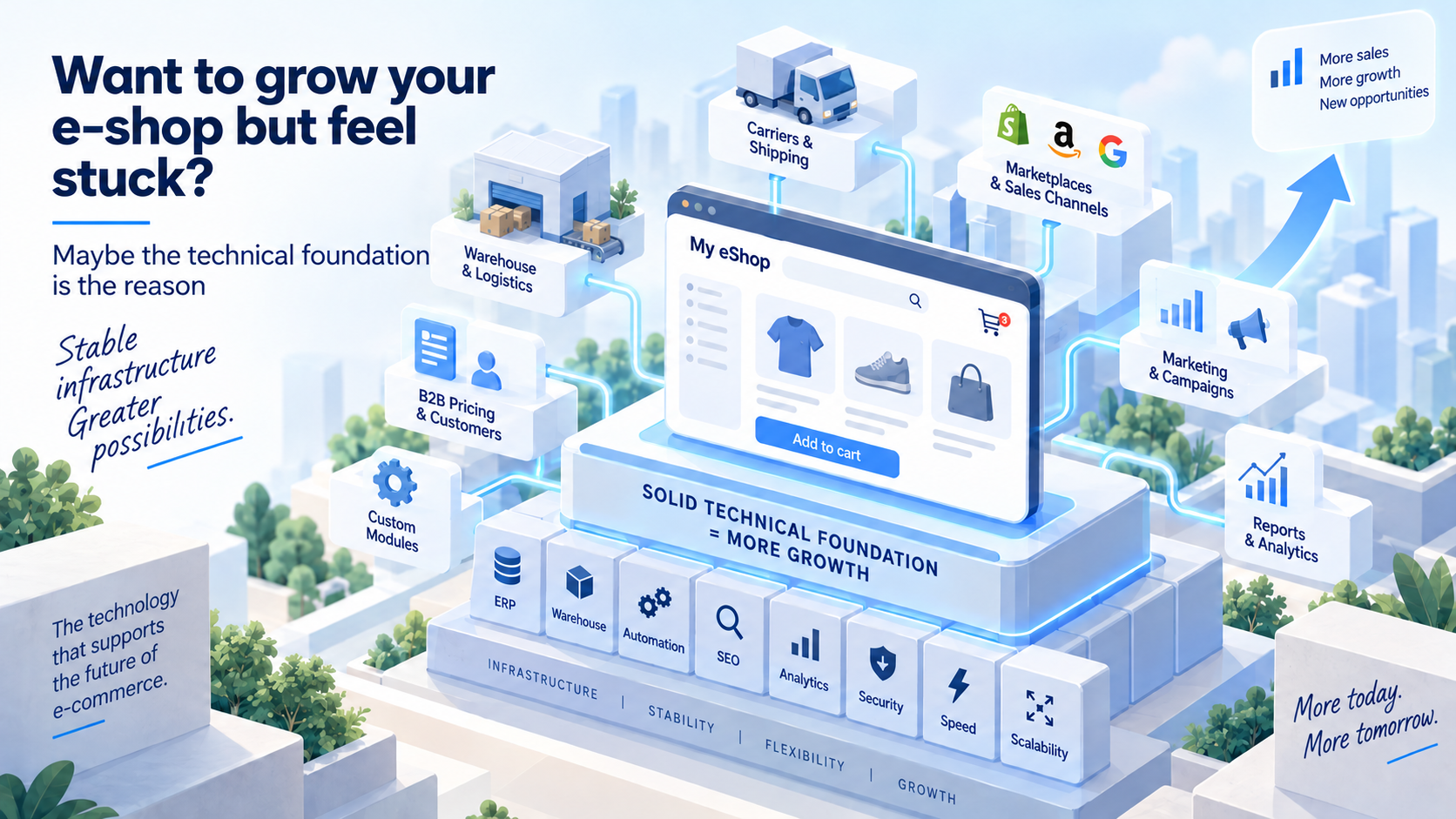
Want to Grow Your Online Store but Keep Hitting Technical Limits?
Your business is growing. You have established relationships with suppliers, built a customer base and developed a product range that sells.
You are investing in advertising, improving your operations and looking for opportunities to expand.
Yet every time you attempt something new, you run into another technical limitation.
Connecting your online store to your ERP is complicated. Introducing wholesale pricing requires workarounds. Automating order processing is apparently impossible. Adding new sales channels creates additional manual work.
Eventually, you reach a frustrating situation: your business is ready to grow, but the technology that should support it is getting in the way.
Not every growth problem can be solved through better advertising or a new marketing campaign.
Sometimes, the real obstacle is the technical foundation of the e-commerce platform itself.
A store that works today may not be ready for tomorrow
When an online store is first built, the requirements are usually straightforward.
You need a product catalogue, payment methods, shipping options and an order management system.
If all those features work, the project may be considered successful.
However, the needs of a growing business are rarely the same as those of a newly launched store.
As sales increase, new requirements begin to appear.
You may need several warehouses, customer-specific price lists, B2B ordering, automated stock synchronisation, ERP integration, marketplace connections or sophisticated promotional rules.
The challenge is not necessarily the absence of these features.
It is whether the underlying implementation can accommodate them without introducing instability, conflicts or excessive development costs.
A store built with maintainability and extensibility in mind gives the business more options as its requirements change.
The warning signs of an e-commerce platform that is holding you back
More sales create more manual work
Imagine that every online order has to be entered into your ERP system by an employee.
At low order volumes, the process may be manageable.
As the number of orders increases, the administrative workload grows alongside revenue. You may need additional staff simply to keep up with data entry.
An appropriately designed integration can transfer orders between systems, synchronise product information and update stock availability automatically.
That investment can become valuable not because it makes the website look better, but because it changes the way the company operates.
The same principle applies to supplier imports, marketplace orders, customer records and inventory management.
Your commercial strategy is limited by the website
Consider a clothing retailer selling matching outfits.
The business wants customers to purchase a set while selecting different sizes for the top and trousers.
Or imagine a wholesaler that needs customer-specific prices, special payment terms and minimum order quantities.
These are ordinary commercial requirements, but standard e-commerce configurations do not always support them.
The business should be able to evaluate whether such functionality can be developed instead of abandoning the idea because an existing plugin cannot handle it.
The same applies to complex shipping rules, warehouse-specific availability and specialised ordering processes.
Your technology should be designed around genuine business requirements, not the other way around.
Performance deteriorates as activity increases
A successful promotion brings additional visitors to your store.
But instead of celebrating the increased traffic, you find yourself dealing with slow pages, unreliable checkout behaviour or background tasks that interfere with the shopping experience.
It is tempting to assume that the answer is simply a more expensive hosting package.
Sometimes additional server resources are necessary. In other cases, the underlying issue lies elsewhere.
Poorly optimised database queries, inefficient modules, unsuitable caching strategies or synchronisation jobs running at the wrong time can all contribute to performance problems.
Without proper diagnosis, increasing hosting expenditure may not resolve the actual cause.
Scalable e-commerce architecture requires attention to both infrastructure and application behaviour.
Custom development can unlock opportunities that standard modules cannot
PrestaShop provides an extensible platform with an established module architecture.
For many common requirements, a ready-made module is a sensible choice. It can reduce development time and avoid unnecessary custom work.
But established businesses often have processes that cannot be adequately represented by a generic plugin.
That is where custom PrestaShop development becomes useful.
Depending on the requirements, a dedicated module or integration might provide:
- ERP connectivity for products, customers, stock and orders.
- Customer-specific wholesale pricing and purchasing conditions.
- Configurable product bundles and specialised product combinations.
- Automated product feeds for marketplaces and advertising channels.
- Shipping and payment rules tailored to the business.
- Automated workflows that replace repetitive administrative tasks.
The objective is not to create custom software for its own sake.
A properly designed module should solve a defined business problem while remaining compatible with the platform's supported extension mechanisms.
Code quality, testing, documentation and future upgrade requirements matter just as much as the initial feature.
Good custom development removes operational friction. Poor custom development simply creates another dependency.
Your technical foundation affects your marketing performance
The relationship between technology and sales extends beyond order processing.
Consider what happens when customers arrive through a Google Ads campaign.
If the landing page loads slowly, product information is incorrect or the checkout experience is unnecessarily complicated, the business may struggle to convert that traffic into sales.
Problems with product feeds can also affect Merchant Center and marketplace integrations.
Incomplete purchase tracking can make it difficult to evaluate campaigns accurately through Google Analytics 4.
Meanwhile, technical SEO issues, poor mobile usability and inefficient page rendering may affect the experience of visitors arriving through organic search.
These are not unrelated technical concerns.
They are connected to the same commercial objective: helping customers discover, evaluate and purchase your products with as little unnecessary friction as possible.
An e-commerce growth strategy should therefore consider development, technical SEO, analytics and commercial operations together.
Should you rebuild your existing online store?
A complete rebuild is not always necessary.
If your current platform is fundamentally sound, targeted improvements may be sufficient.
That could mean replacing problematic modules, upgrading the installation, improving performance or introducing new integrations.
In more complicated cases, accumulated custom modifications, incompatible extensions or outdated technology may make a broader restructuring more sensible.
The decision should begin with a technical assessment.
Identify which processes are limiting growth, which changes are commercially important and which components can be retained.
Then build a development plan that prioritises improvements according to their expected business value, technical complexity and ongoing maintenance requirements.
That approach is more useful than starting again simply because a newer design or platform version is available.
Build for the business you want to become
You have already invested in your products, customer relationships, operations and market presence.
Your next phase of growth should not depend on whether a developer can find a ready-made plugin for every new requirement.
At Hot Web Design, we develop PrestaShop stores, custom modules and integrations designed around business requirements.
Our work covers e-commerce development and a range of PrestaShop modules that extend the platform's functionality.
Whether you need to modernise an existing store or build capabilities for a growing operation, the starting point is understanding what your business actually needs.
The question is not just whether your store can handle today's orders. It is whether it can support the business you are working to build.
Contact Hot Web Design to discuss your technical requirements and the options available for developing your online store.