

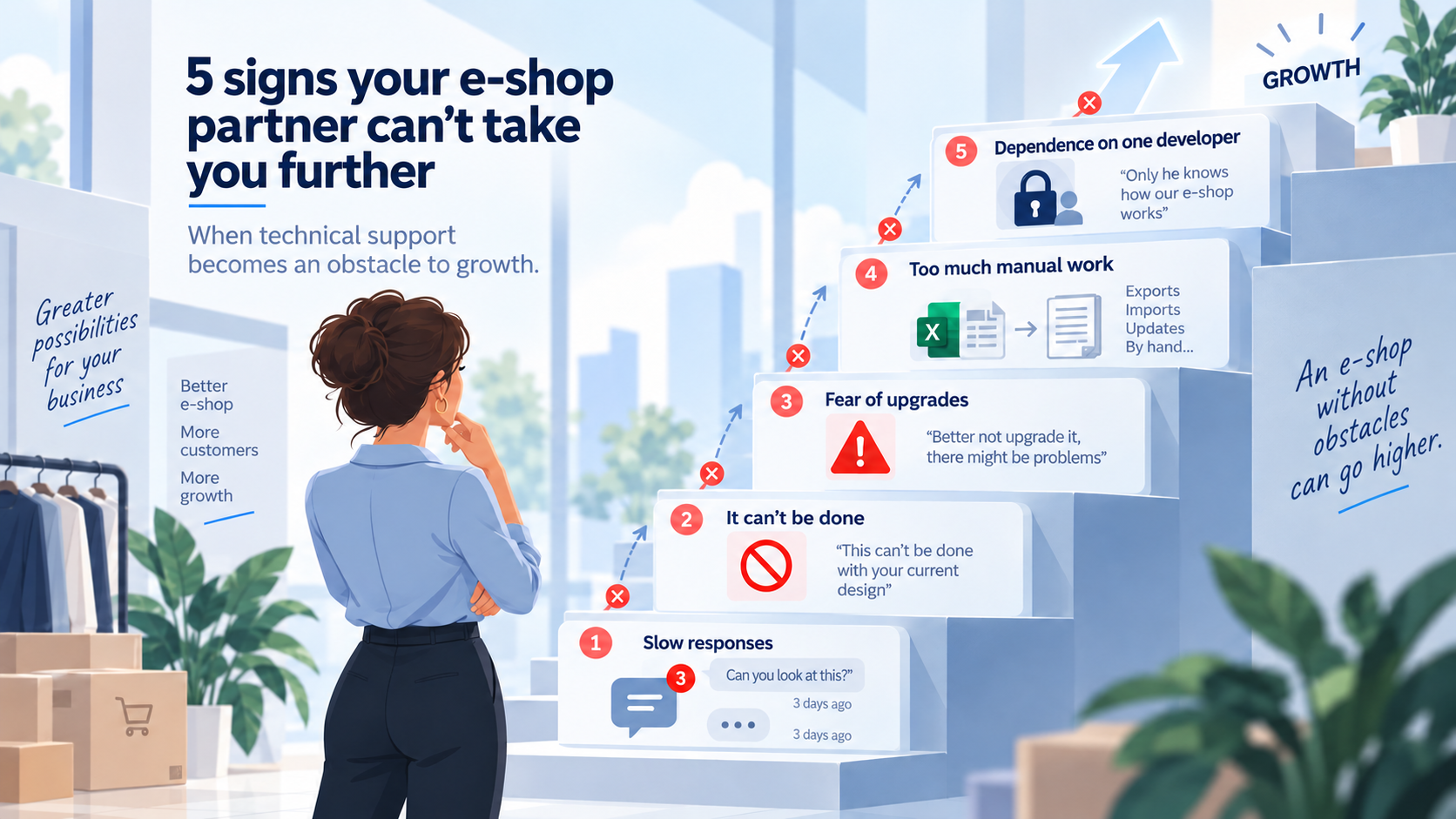
5 Signs Your E-commerce Developer Can No Longer Support Your Growth
You have an idea that could improve your online store. Perhaps you want to connect it to your ERP system, automate a repetitive task, introduce a new pricing structure or make the shopping experience easier for your customers.
You contact the company that built your website.
Days pass. You follow up. Eventually, you receive the familiar response: "We'll look into it."
Or worse: "That's not possible."
The idea gets postponed. Then another one. Eventually, you stop suggesting improvements because you already know how difficult the conversation is going to be.
When you begin adapting your business plans to the limitations of your developer, something is wrong with the relationship.
Running an e-commerce business is demanding enough without having to chase the people responsible for keeping its technology working.
Here are five signs that the developer or agency behind your online store may no longer be the right technical partner for your business.
1. Getting a response has become a project of its own
Technical issues happen. Even well-maintained stores occasionally require urgent fixes, compatibility updates or unexpected troubleshooting.
What matters is how those situations are handled.
You should not have to send repeated emails simply to find out whether someone has acknowledged a problem. Nor should you be left wondering when a promised modification might finally be completed.
Not every request can be resolved immediately. Some changes require investigation, development time and testing. But a professional support arrangement should provide clear communication, priorities and realistic expectations.
This becomes particularly important when technical delays affect actual sales.
A payment method that stops working, a broken stock synchronisation process or a promotional campaign that cannot launch on time is not merely a development inconvenience. It can affect customers, staff and revenue.
Reliable e-commerce support means having someone who takes responsibility for technical issues and communicates clearly about their resolution.
2. Every new idea is met with "that can't be done"
You want to offer different prices to wholesale customers. Sell a bundle where buyers can choose sizes for individual items. Introduce a special checkout process or automate information flowing between your website and another business system.
Your developer tells you that the platform does not support it.
Sometimes, that is a reasonable answer. A request may involve complex technical constraints, considerable cost or compatibility risks.
But there is an important distinction between a feature that is not available out of the box and one that cannot reasonably be developed.
Platforms such as PrestaShop can be extended through modules, APIs, integrations and custom development.
A technically capable partner should be able to evaluate your requirements and explain whether an existing solution can meet them, whether custom development would be appropriate and what the cost and maintenance implications might be.
You may decide that a particular feature is not worth the investment. That is a business decision.
You should not be forced to abandon an idea simply because your current developer only knows how to install ready-made plugins.
3. Every software update feels like a major risk
You ask about upgrading your e-commerce platform and hear that it might break the entire store.
The discussion repeats whenever a new version becomes available. Months turn into years, and the store remains on an increasingly outdated installation because nobody wants to touch it.
Software upgrades genuinely require care.
Themes, third-party modules and custom integrations must be assessed for compatibility. Significant upgrades may require code changes and extensive testing.
However, those challenges should lead to a controlled upgrade process, not indefinite avoidance.
A well-maintained store should have reliable backups, a separate staging environment where appropriate, documented customisations and a recovery plan for failed deployments.
If even minor updates require emergency repairs or improvised fixes, the problem may lie in the quality of the original implementation or its ongoing maintenance.
Delaying necessary technical work can also make future upgrades more difficult and expensive.
4. Your store takes orders, but your team still does everything manually
Your website may appear to work perfectly from a customer's perspective.
Behind the scenes, however, your employees might be copying orders into the ERP, updating stock through spreadsheets, correcting catalogue information or repeatedly checking whether prices have synchronised correctly.
These processes can seem manageable when order volumes are low.
As the business grows, they consume more staff time and create additional opportunities for errors.
This is where e-commerce development needs to extend beyond website design.
ERP integration, automated inventory updates, marketplace feeds, customised order workflows and business-specific modules can reduce unnecessary manual work.
The objective is not to automate absolutely everything. It is to identify where technical improvements can deliver measurable operational benefits.
A good development partner understands not only how your website works but also how your business operates.
5. You are dependent on your developer for everything
You decide to obtain a second opinion or consider working with another agency.
Suddenly, you discover that you do not have all the access credentials.
You are unsure who controls the hosting account, where the backups are stored or what custom modifications have been made to the original software.
Perhaps no technical documentation exists.
This lack of transparency can make changing providers unnecessarily difficult.
Your business should have appropriate control over its domain, hosting arrangements, data and contractual deliverables. Custom work should be documented sufficiently to support maintenance and a safe handover.
A developer provides expertise and services. They should not become an obstacle to your business's ability to make independent decisions.
Do you need a new website or simply a better technical partner?
Not necessarily a new website.
An online store suffering from poor support may still have a solid technical foundation.
Before investing in a complete rebuild, it is worth conducting a technical review of the existing platform, modules, integrations, security, performance and maintainability.
Some businesses need targeted improvements and better ongoing support. Others may require more substantial restructuring.
The right decision depends on the condition of the store and the requirements of the business, not on a blanket recommendation to start again.
Your online store should support your ideas, not discourage them
You should be able to discuss new commercial opportunities without expecting every suggestion to become a technical argument.
That does not mean your developer should agree with everything. It means they should understand what you are trying to achieve, investigate your options and provide a practical explanation.
At Hot Web Design, we work on PrestaShop development and e-commerce solutions, including custom functionality, technical improvements and integrations with external business systems.
We can review an existing online store, identify its limitations and help determine which changes are worth making.
Have an idea your current developer cannot implement? Get in touch and tell us what you are trying to achieve.
You may not need to rebuild your store. You may simply need a technical partner who can help you move forward.